
Appearance Form — JD-CL-12
Explore an illustrative Appearance, including both signatures, printed names, dates and certification. Turn the example off to see the untouched blank form.
On a phone the form is wider than the screen so the sample stays readable. Slide it sideways to see the whole page.
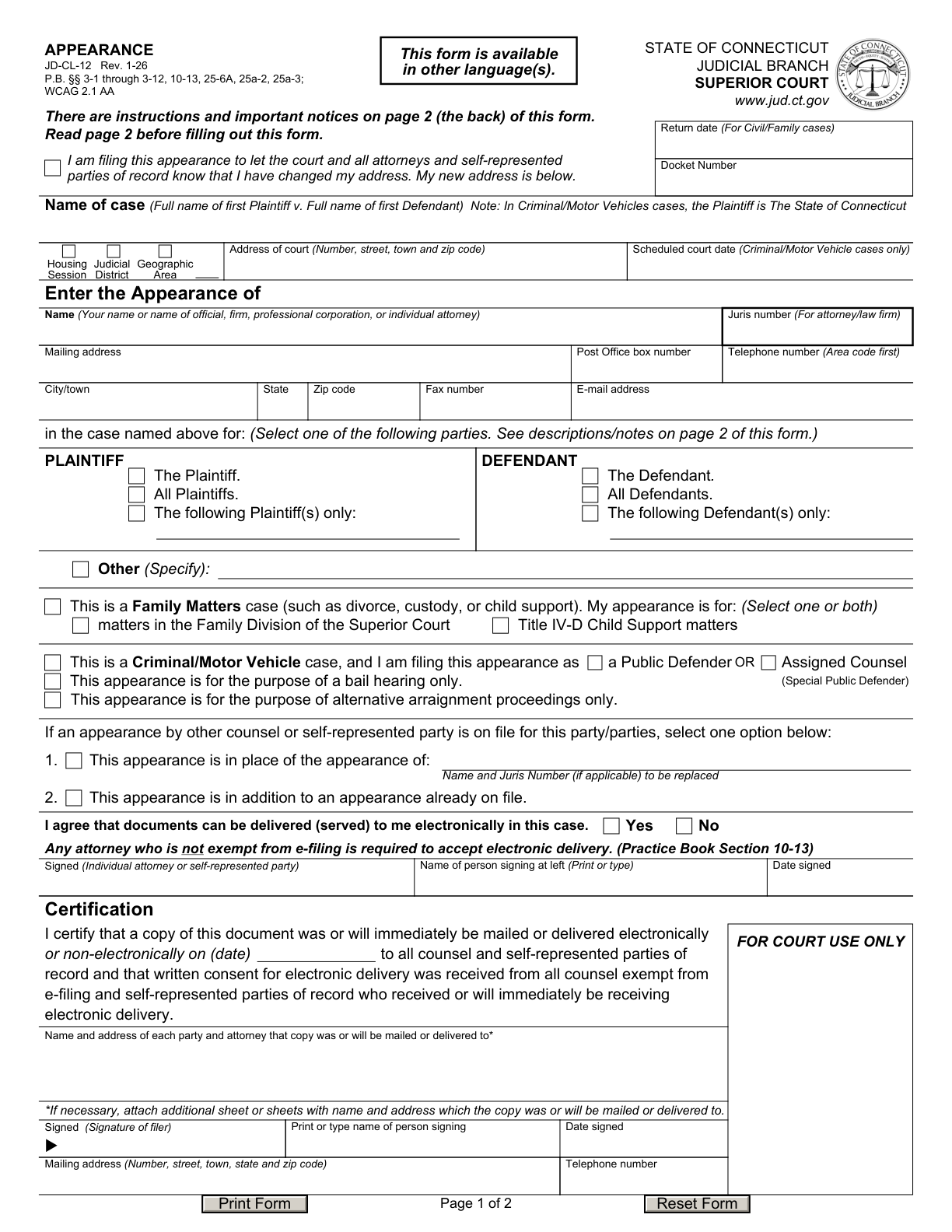
What the sample shows
Jane Q. Homeowner, Example Bank and attorney Alex Sample are fictional. The sample shows where names, contact details, signatures, printed names, signing dates, mailing dates and recipient details go.
All checkbox questions and consent choices are unselected. These sections still need to be completed as directed by the official form; blank choices in this illustration do not mean they can be skipped.
The italic names illustrate signatures. They are not actual signatures or instructions about an acceptable signing method. The sample is not a completed filing.
What does “return date” mean?
The return date appears on the summons. It is a reference date used for case deadlines—not the day the papers arrived at your home.
Return date
Used to work out certain filing deadlines. The official civil summons says an Appearance is generally due by the second day after this date.
Hearing or appointment date
A separate notice tells you when and how to attend a court event. A return date alone is not an appointment to appear before a judge.
The summons says you do not have to attend court on the return date unless a separate notice tells you to appear. This does not remove filing deadlines or other requirements.
This page does not calculate a deadline for your case. A lawyer can explain how the dates and requirements apply to your circumstances.
Source: official Civil Summons, notice to each defendantWhy might the location look different?
The statewide Appearance form is the same. The district, court location and court address depend on the case. The court address is separate from the homeowner’s mailing address.
| What you see | What it means | Example |
|---|---|---|
| Town | Where a home or mailing address is located. | Hamden |
| Judicial district | A court area covering a group of towns. | New Haven Judicial District includes Hamden. |
| Court location | The location identified for the case within that district. | New Haven or Meriden |
| Address of court | The court’s street address on the case papers. | The overlay uses 235 Church Street, New Haven, as an illustration. |
Connecticut law allows civil cases brought to New Haven Judicial District to be returnable at New Haven or Meriden. That is why “New Haven Judicial District” does not always mean the same courthouse.
The location on the actual summons and court notices matters. A sample address—or the nearest courthouse—is not enough to identify where a particular case belongs. Court staff can help clarify location information.
Source: Connecticut General Statutes §§ 51-344, 51-346 and 51-347Why are questions and choices blank?
This guide explains the questions without answering them. Complete applicable sections using the actual facts and the official instructions. Court-use-only fields remain for court staff. Some conditional sections may not apply; their instructions explain when they are used.
Illustrative names, signatures and dates are included to show field placement. They are not information to copy into a real filing.
Official form and sources
Appearance form and instructions · JD-CL-12
Civil Summons · JD-CV-1
Judicial districts and court locations · Chapter 890
Form snapshot: Rev. 1-26. Sources reviewed September 15, 2026. Use the official link for the current downloadable form.
General information only, not legal advice. The form images above are pictures of the official blank form; the official PDF at jud.ct.gov is the accessible, fillable version and the only one to file. Foreclosure Clarity is a guide, not a law firm. This viewer does not accept or submit case information.
EDUCATIONAL VIEWER — FICTIONAL SAMPLE — NOT FOR FILING